Descriptions and Samples for the POV-Ray Raytracer
by Friedrich A. Lohmüller

Deutsch

|
Italiano
Deutsch
|
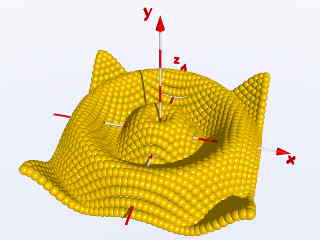
Untill now we applied sine function only in x direction. A very charming effect will appear if we use a sine modultion to the y position of each sphere depending from here distance of the center. The distance of a point from the origin in cartesian coordinates is calculated by calculating the square root of sum of the sqare of the X value plus the square of Z value - as Pythagoras found out somewhat before.
#declare Ball = sphere{<0,0,0>,0.25
                        texture{pigment{color rgb<1,0.65,0.0>}
                                finish {ambient 0.1 diffuse 0.9 phong 1}
                               }// end of texture
                       }// end of sphere

#declare Z = -5;    // start value Z
#declare EndZ = 5;  //   end value Z
#declare Step = 0.5;// step value

#while ( Z < EndZ + Step)//-------------- loop start Z

   #declare X = -5;   // start value X
   #declare EndX = 5; //   end value X
   #while ( X < EndX + Step)//------------ loop start X

      #declare R = sqrt(X*X + Z*Z); // calculation of the distance from the origin
      object{ Ball translate < X, sin(2*R), Z> } // modulated depending from R

   #declare X = X + Step; //next X  value
   #end // --------------------------------- loop end X

#declare Z = Z + Step; //next Z value
#end // ------------------------------------ loop end Z
 |
Mit
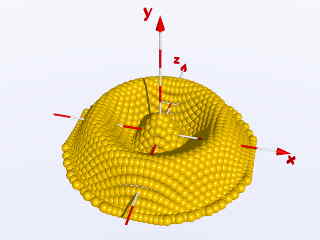
#declare R = sqrt( X * X + Z * Z);
#if (R < 5)
object{Ball translate< X, cos(2*R), Z>}
#end
If you limitate the distance from the y-axis on R < 5
and use cos(A) instead of the sine:
 |
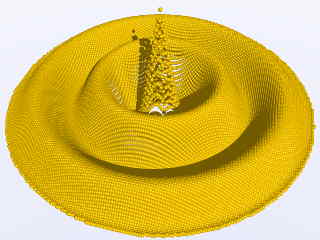
Reducing the radius and increasing the density of the spheres will increase the number of objects to calculate immense - in the following scenery there are about 20000 spheres in game and it needs about 14 MB RAM to caculate it. In addition the y-value of the spheres was modulated antiproportional to the distance R from the central y-axis.
#declare Ball =
sphere{<0,0,0>,0.1
       texture{pigment{color rgb<1,0.8,0>}
               finish {ambient 0.45 diffuse 0.55 phong 1}}}
#declare E = 8;
#declare Z = -E;    // start value Z
#declare EndZ = E;  //   end value Z
#declare Step = 0.1;// step value
#while ( Z < EndZ + Step)//-------------- loop start Z

  #declare X = -E;    // start value X
  #declare EndX = E;  //   end value X
  #while ( X < EndX + Step)//------------ loop start X
    #declare R = sqrt( X * X + Z * Z);
    #if (R < E)
     object{Ball translate< X, 5/(R+1)*cos(2*R), Z>}
    #end
  #declare X = X + Step; // next X value
  #end // --------------------------------- loop end X

#declare Z = Z + Step; // next Z value
#end // ----------------------------------- loop end Z
 |
| loops and sine |  |
 |
About flying carpets |
© Friedrich A. Lohmüller, 2004 email:
(legacy email redacted) email:
(legacy email redacted)homepage: |